C-Lock Symposium: Breeding dairy cows for lower methane: Genetics shows promise as scalable solution
University of Wisconsin-Madison research shows methane is heritable and linked to feed efficiency, opening the door for faster genetic progress
 1 June 2026
 7 minute read
 By:
By: New research is pointing to genetic selection as a powerful, long-term solution for methane mitigation in dairy systems.
Speaking at the C-Lock Symposium in Denver, Colorado, Dr. Francisco Peñagaricano, Associate Professor and Judge John Crow Chair in Dairy Genetics at the University of Wisconsin–Madison, outlined how advances in methane measurement using C-Lock’s GreenFeed systems are enabling researchers to identify and breed more environmentally efficient dairy cows.
While the symposium largely focused on beef systems, Peñagaricano provided a dairy perspective, emphasizing how genetics, combined with emerging technologies, could reshape sustainability in the sector.
Sustainability starts with the cow
Peñagaricano framed his presentation around a holistic view of sustainability that balances economic, social and environmental priorities.
“I like this definition that sustainability is all about meeting the needs of the present without compromising the ability of future generations to meet their own needs,” he said.
For dairy producers, that definition translates into a complex set of goals including profitability, productivity, animal welfare and environmental stewardship – all centered on the cow.
“When we think about sustainable dairy farming, we would like to have high producing, fertile, long-lived healthy cows, high feed efficiency, low methane emissions and of course, we would like to have resilient cows,” Peñagaricano explained.
The challenge is achieving all these traits simultaneously, particularly methane reduction, which has become a focal point in climate discussions.
Why methane matters
Methane plays a disproportionate role in livestock’s environmental footprint, and Peñagaricano highlighted both its risks and opportunities.
“Enteric fermentation accounts for about 27% of methane emissions in the U.S., and this represents quite a unique opportunity for both the dairy industry and the beef industry to reduce methane emissions,” he said. “Methane has much more warming power than CO2 and at the same time has a shorter atmospheric lifespan than CO2.”
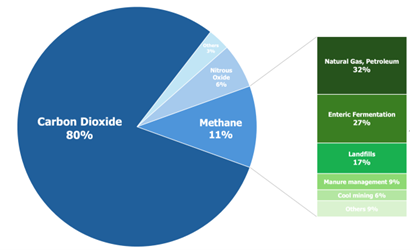
That shorter lifespan of CO2 means reducing methane emissions can deliver faster climate benefits compared to CO2 mitigation. From a production standpoint, methane also represents inefficiency.
“Methane energy represents between 5% to 10% of energy loss, energy that otherwise could be used for production and growth,” he noted.
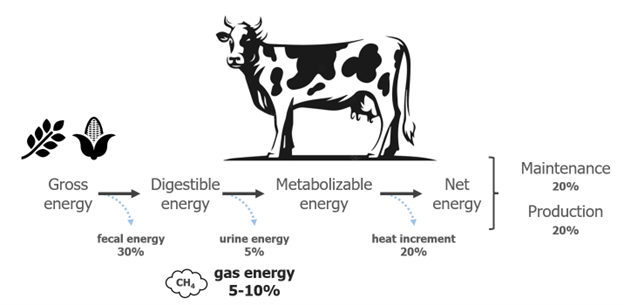
For dairy producers, this creates a dual incentive: reducing methane can both improve environmental outcomes and increase feed efficiency.
Despite decades of research into methane mitigation, progress has been uneven. Peñagaricano referenced a large meta-analysis evaluating 430 peer reviewed studies looking at 98 different enteric mitigation strategies.
“The vast majority of the options that we have available – they simply don’t work,” he said.
Only eight interventions – primarily dietary or management-based – reduce methane without negatively affecting animal performance.
“Overall, we still have many challenges in identifying effective strategies,” he added, emphasizing that any solution must meet both producer needs and consumer expectations.
This is where genetics stands apart.
Genetic selection: permanent, cumulative and scalable
Peñagaricano positioned selective breeding as one of the most promising tools for methane reduction.
“Genetic selection is likely the most cost-effective strategy that we have to reduce environmental impact,” he said.
Unlike nutritional or management interventions, genetic improvements are:
- permanent
- cumulative
- incremental
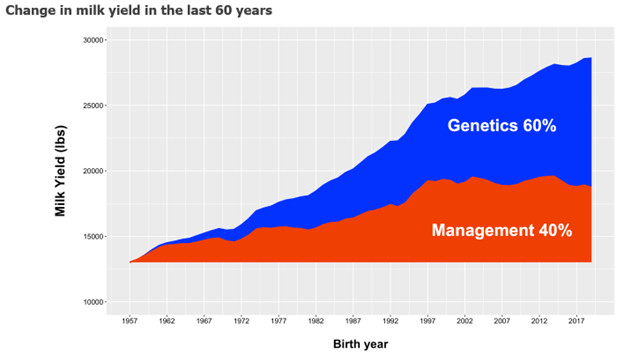
The dairy industry has already demonstrated the power of genetics. Over the past 60 years, milk production per cow has more than doubled in the U.S., with about 60% of that gain attributed to genetic selection.
However, methane is not yet part of routine breeding indices.
“If a farmer today wants to breed cows for low methane emissions, we do not have the tools yet,” Peñagaricano said. “But we are working on it. My team is working on developing a national genetic evaluation for methane emissions.”
Measuring methane: the role of GreenFeed
A key barrier to genetic selection has been the ability to accurately measure methane at scale. That is where the GreenFeed system comes in.
Peñagaricano’s team is using GreenFeed units across research and commercial farms to collect detailed methane data, supported by new analytical tools developed in-house. The GreenFeed system allows researchers to capture methane emissions in grams per day, providing a robust foundation for genetic evaluation.
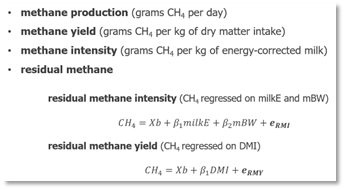
“We are measuring two different residual methane traits. One is residual methane intensity, where we have methane as a response variable and we adjust methane for milk energy,” he said. “The second we call residual methane yield where we have methane but adjust methane for dry matter intake.”
One of the most striking findings from this work is the natural variation between cows.
“In the same place, same time, same diet, we have 64 second lactation Holstein cows on one of our research farms that average 450 grams of methane a day,” he explained. “But we have cows that produce 600 to 650 grams of methane, and we have cows that produce 300 grams of methane.”
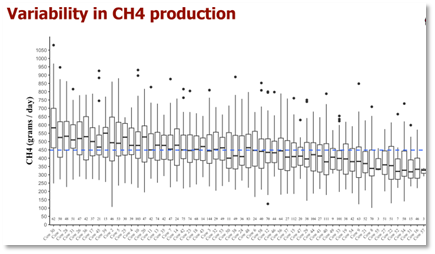
That variation is critical.
“Geneticists love variation because genetic progress depends on having variation,” he added.
Methane is heritable – and selectable
Heritability sets the pace of genetic progress, making it a very relevant parameter.
Using data from approximately 3,500 cows across commercial and research farms, Peñagaricano’s team has demonstrated that methane emissions are moderately heritable.
“Methane production is heritable with a heritability of almost 30%,” he said.
For context, milk production has a heritability of about 20%, and it has seen dramatic improvement over time with 60% of that change due to genetic progress.
Residual methane traits – adjusted for production, body weight or intake – also show meaningful heritability of about 20%. This opens the door for genetic progress.
“Imagine how fast we can move forward with this trait that has a heritability of 30%,” Peñagaricano said.
One of the most important discoveries from this research is the relationship between methane emissions and feed efficiency.
“There is a positive large genetic correlation between methane production and residual feeding intake,” Peñagaricano explained.
In practical terms:
- High methane cows tend to be less feed efficient
- Low methane cows tend to be more feed efficient
This favorable correlation means producers may be able to improve both traits simultaneously and faster through selection – a significant advantage for sustainability and profitability.
Accelerating progress through bull selection
To scale methane reduction, researchers are exploring whether methane emissions in young bulls can predict performance in their daughters.
“It will be much easier to phenotype bulls than phenotype the daughters of the bulls,” Peñagaricano noted.
Preliminary data from 150 Holstein bulls shows wide variation in methane output, even at a young age.
More importantly, early results suggest correlations between bull methane emissions and key production traits in daughters, including feed efficiency.
The preliminary data shows bulls that tend to produce more methane tend to have daughters that will produce more fat and protein, which is not a surprise, according to Peñagaricano, due to the connection between fat yield and the microbiome.
“We also found that bulls that tend to produce more methane tend to have daughters that are less feed efficient,” he said.
If confirmed, this approach could significantly accelerate genetic progress by focusing selection on a relatively small population of breeding animals.
Precision tools: milk spectra and microbiome
Beyond genetics, Peñagaricano highlighted emerging tools to identify high- and low-methane cows without direct measurement. One promising approach uses milk spectra-based data solutions, which use infrared light to create a chemical fingerprint of a milk sample’s composition by measuring light absorption of molecules.
“As soon as you incorporate spectra to the model, you boost the prediction ability,” he said, noting prediction accuracy can increase from roughly 30% to 60%.
Another avenue is the microbiome.
“Cows with divergent methane emissions have different fecal microbiome profiles,” he explained. “That means we can use fecal microbiome to predict methane emissions.”
Researchers found that:
- A large portion of the microbiome is heritable
- Certain microbial traits are strongly correlated with methane emissions
This raises the possibility of using microbiome indicators as indirect selection tools.
Rethinking feed efficiency
Peñagaricano also addressed the broader challenge of measuring feed efficiency, a key component of sustainable dairy production. Residual feed intake (RFI) is widely used, but has limitations, including cost, it’s labor intensive to capture and it’s an incomplete representation of metabolic efficiency, meaning it doesn’t account for what the cow needs for maintenance versus production.
His team is exploring an alternative: residual heat production.
“We have a protocol that I can deploy at the national level using the GreenFeed data,” he said.
Results show that residual heat production is:
- Heritable
- Repeatable
- Biologically distinct from residual feed intake
“The genetic correlation between dry matter intake and heat production is very high at 0.80,” he said. “The genetic correlation between these two alternative ways to measure dairy cow feed efficiency is 0.50, which means these traits are correlated,” he noted, indicating they capture different aspects of efficiency.
Future selection indices may combine both traits to provide a more complete picture of efficiency.
The path forward in dairy
As consumer scrutiny of livestock production intensifies, Peñagaricano emphasized the importance of practical, scalable solutions.
“Any mitigation strategy that we plan to develop and implement should meet farmer needs and consumer demands,” he said.
For producers, that means solutions must be cost-effective and easy to adopt. For consumers, they must support animal welfare and food quality.
Genetics offers a pathway to achieve both.
“Genetic selection is a critical tool to improve dairy sustainability,” Peñagaricano concluded.
However, key questions remain, including the economic value of methane reduction and the best way to measure efficiency.
As research continues, one message is clear: the future of sustainable dairy production will be driven not just by what cows eat – but by how they are bred.
Watch Dr. Peñagaricano's presentation from the C-Lock Symposium here.


Sarah Mikesell
Sarah Mikesell grew up on a five-generation family farming operation in Ohio, USA, where her family still farms. She feels extraordinarily lucky to get to do what she loves - write about livestock and crop agriculture. You can find her on LinkedIn.