GreenFeed sets the global standard for measuring enteric methane
Flux-based measurement and global calibration distinguish GreenFeed from respiration chambers and concentration-based systems
 10 June 2026
 3 minute read
 By:
By: Accurately measuring enteric methane emissions from cattle has become one of the most consequential technical challenges in livestock sustainability. Methane reduction strategies based on genetics, nutrition or management all depend on a single foundation – data that is accurate, repeatable and comparable across studies and geographies.
While multiple methane measurement technologies exist, only one system consistently meets all three criteria at scale. That system is GreenFeed, by C-Lock.
Accuracy is not optional; it is foundational
Methane emissions are a mass flow problem, not an air-quality problem. What matters scientifically is not how much methane is present in a pocket of air, but how much methane leaves the animal per unit of time, typically expressed in grams per day.
GreenFeed directly measures methane mass flux by inducing and controlling airflow through the system at approximately 40 liters per second, collecting a high proportion of the animal’s emitted gases. This approach mirrors the governing equations used in respiration chambers, with one critical difference: GreenFeed is designed for real-world, on-farm conditions.

Caption: Direct comparisons show strong agreement between GreenFeed and respiration chambers (R² ≈ 0.92), confirming GreenFeed delivers chamber-equivalent accuracy under real farm conditions.
Concentration-based systems, such as sniffers, measure methane in parts per million (ppm) without measuring airflow. Without airflow, true mass flux cannot be calculated. This is not a methodological preference but rather a physical limitation.
As a result, GreenFeed produces data in universally recognized units (g/day) that are suitable for:
- Peer-reviewed research
- Genetic evaluations
- Carbon accounting
- Feed additive validation
- Prediction models for intake and feed efficiency
- Rumen microbiome studies
Global standardization is the defining advantage
Accuracy alone is not sufficient if results cannot be compared across studies.
Respiration chambers, while effective within individual laboratories, are not globally standardized. Each chamber is uniquely constructed, calibrated and operated. Results from one chamber facility cannot be assumed equivalent to results from another.
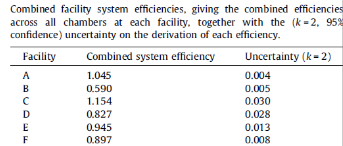
GreenFeed is fundamentally different.
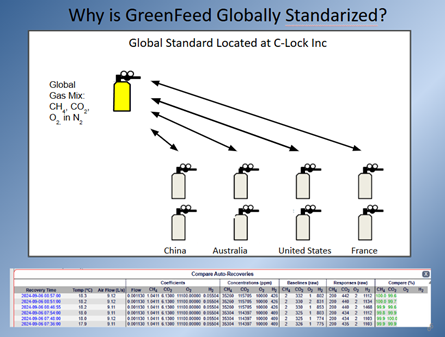
Every GreenFeed unit worldwide shares:
- Identical system design
- Identical airflow rates
- Identical sensor packages
- Standardized calibration gases and procedures
- Uniform data algorithms
- Centralized quality-control review
This means methane data collected in North America, Europe, Asia and Australia is directly comparable — something no other measurement method can claim.
This standardization is why GreenFeed has been adopted globally and why its data appears consistently in peer-reviewed literature, national inventories, and large-scale meta-analyses.
Proven head-to-head against respiration chambers, repeatedly
Multiple independent studies have compared GreenFeed directly with respiration chambers. Across these comparisons, GreenFeed has demonstrated correlations approaching R² ≈ 0.92, confirming that it provides chamber-equivalent accuracy under field conditions.
Importantly, large meta-analyses have shown that residual and random errors in GreenFeed data are often lower than those observed between respiration chambers themselves, highlighting the benefit of standardized calibration and operation.
This level of agreement has established GreenFeed as the field-deployable reference method for methane measurement.
Why variability matters and how GreenFeed avoids it
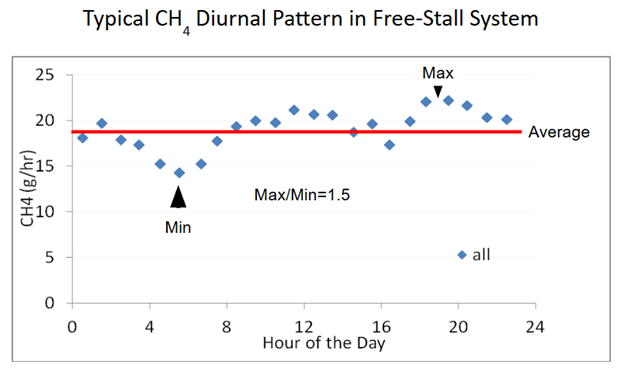
Methane emissions from cattle vary over the day in response to intake, rumen fermentation and feeding behavior. Any valid measurement system must capture this natural variation without introducing bias.
GreenFeed does this through:
- Repeated measurements (20–30+ visits per animal)
- Automated filtering of valid data using head-position sensors
- Background gas correction
- Controlled airflow
When sufficient samples are collected, diurnal bias from spot sampling is typically less than 5%, far smaller than errors introduced by calibration drift, dilution or airflow uncertainty.
Concentration-based systems, by contrast, show high variability within animals, between animals and between farms.
Scientific adoption reflects scientific confidence
The global research community has voted with its data.
To-date, GreenFeed appears in more than 800 peer-reviewed publications, including:
- Feed efficiency studies
- Genetic selection trials
- Methane inhibitor validation
- Long-term mitigation experiments
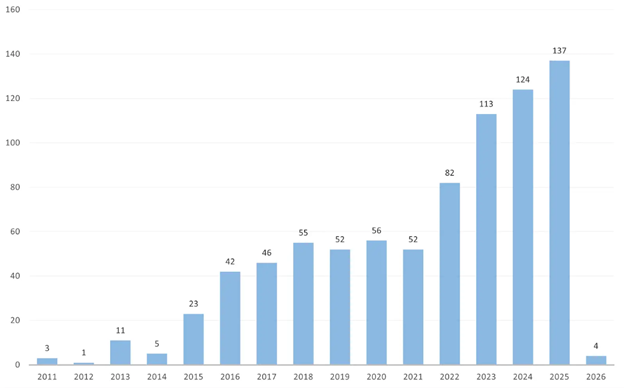
Sniffer-based studies, while numerous, show wide methodological divergence and inconsistent reporting metrics, limiting their interpretability and comparability.
When methane data must be:
- Accurate
- Standardized
- Comparable across time and geography
GreenFeed is not simply the best option – it is the only viable option.
Other methods may provide partial insights or exploratory screening, but they cannot replace the GreenFeed globally standardized, flux-based measurement system.

Sarah Mikesell
Sarah Mikesell grew up on a five-generation family farming operation in Ohio, USA, where her family still farms. She feels extraordinarily lucky to get to do what she loves - write about livestock and crop agriculture. You can find her on LinkedIn.