Mycotoxin monthly survey: January 2026
The third update from the 2025 PROcheck mycotoxin survey is here!
 30 January 2026
 1 minute read
 By:
By: 2025 US and Canada Corn Ingredient Survey Reports
A-Trichothecenes (A-Trich): T-2 toxin, HT-2 toxin, Neosolaniol*, Diacetoxyscirpenol
B-Trichothecenes (B-Trich): Deoxynivalenol (DON/Vomitoxin), 3-Acetyl-deoxynivalenol, 15-Acetyl-deoxynivalenol, Nivalenol*, Fusarenon X*
Fumonisins (FUM): B1, B2, B3*
Zearalenone (ZEN)
Aflatoxins (Afla): B1, B2, G1, and G2
Ochratoxin A (OTA)
In Canada, samples are also routinely screened for Mycophenolic Acid (MPA) and Sterigmatocystin (STC).
*Not screened for in Canada
The survey results represent samples sent in for surveillance testing only and does not include any sample submitted following clinical signs.
Below we discuss trends of each of these feed ingredients regarding mycotoxin occurrence. Additional details including mean contamination levels and risk by state or province can be found by downloading the full report.
USA Corn
199 samples submitted from 18 states.
Overall occurrence for corn samples:
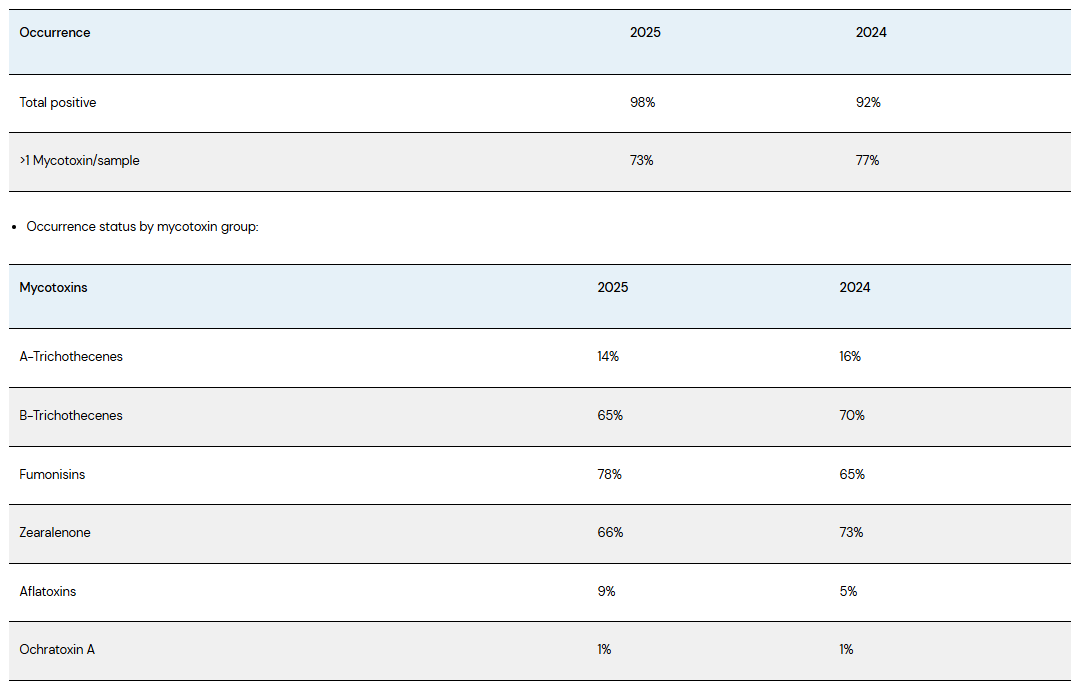
Based on the 199 corn grain samples tested to date, surveillance of 2025 crop suggests an increase in the occurrence of Fumonisins and Aflatoxins (+13% points and +4% points, respectively) while A-Trichothecenes are similar (-2% points) and B-Trichothecenes and Zearalenone occurrence appears to be slightly down (-5% points and -7% points, respectively) vs. 2024 crop year results.
It is important to keep in mind that as of August 1, 2023, Romer Labs implemented the updated PLUS Method featuring enhanced sensitivity. Changes in laboratory methods including lowered limits of detection (LOD) may influence historical comparisons vs. 2023 through 2025 survey results.
USA Corn Silage
This data set will be updated once more samples are screened as part of the survey.
Canada Corn
This data set will be updated once more samples are screened as part of the survey.
Canada Corn Silage
This data set will be updated once more samples are screened as part of the survey.
Continued monitoring and surveillance of 2025 crop ingredients is warranted to provide on-going characterization of contamination patterns and trends in North America. Keep in mind the potential for storage contamination to increase over time.
Results based on the samples analyzed in the region to date.